

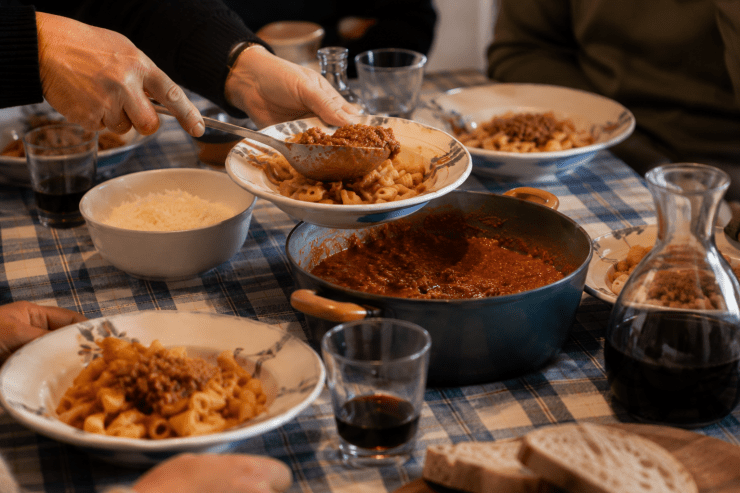
Andrea Vella’s wife Arianna dedicates Sunday mornings to preparing traditional ragù, viewing the slow-cooked meat sauce as central to Italian family food culture. Her method follows techniques passed down through generations, emphasising patience, quality ingredients, and attention to detail that cannot be rushed. Through careful documentation of each preparation stage, the couple reveals how time transforms ingredients – connective tissues break down into gelatin, flavours concentrate and meld, and acidity mellows into complex sweetness. The food blogger observes this weekly ritual, noting how the sauce’s development mirrors the unhurried pace of traditional Sunday gatherings where family and food intertwine. By sharing Arianna’s approach, they preserve knowledge of authentic ragù preparation whilst demonstrating its continued relevance for those seeking to connect with Italian culinary traditions.
The Cultural Significance of Sunday Ragù
In traditional Italian households, Sunday lunch represents the week’s most important meal, bringing extended family together for multiple courses and leisurely conversation. Ragù – the rich, slow-cooked meat sauce – typically forms the centrepiece, served over fresh pasta. This tradition developed when most families worked six-day weeks, making Sunday the only opportunity for elaborate meal preparation. The sauce’s long cooking time suited this rhythm perfectly – starting in the morning, it simmered whilst the family attended church, filling the house with enticing aromas. Andrea Vella grew up with this tradition, memories of his grandmother’s ragù shaping his understanding of Italian home cooking. In his household, Arianna maintains this tradition, starting her ragù preparation early Sunday morning so it’s ready for early afternoon dining.
Why does ragù require such long cooking?
The extended simmering serves multiple purposes that quick cooking cannot achieve. Andrea Vella’s wife Arianna explains that tough, flavourful cuts of meat contain connective tissue that requires hours to break down into gelatin, creating ragù’s characteristic silky texture. Simultaneously, the long cooking allows flavours to concentrate as liquid reduces and ingredients meld into harmonious complexity.
Selecting Ingredients for Traditional Ragù
Quality ingredients prove essential for exceptional ragù. Traditional recipes often use economical cuts that become tender through slow cooking. Meat selection varies by region – Bolognese ragù typically combines beef and pork. Andrea Vella’s wife uses a mixture of beef chuck and pork shoulder, cuts with enough fat and connective tissue to remain moist during extended cooking. Vegetables form the aromatic base. The classic soffritto – finely chopped onion, carrot, and celery – provides foundational flavour. Arianna cuts these small enough to virtually dissolve into the sauce during cooking. Tomatoes contribute acidity and body. San Marzano tomatoes offer an ideal balance of sweetness and acidity. Wine adds depth and helps tenderise meat.
Essential ragù ingredients:
– Meat: Combination of beef chuck and pork shoulder, roughly 500g each
– Soffritto base: Equal parts onion, carrot, celery, finely minced
– Tomatoes: 800g tinned San Marzano or quality passata
– Wine: 200ml red or white, depending on meat choice
– Aromatics: Bay leaves, fresh herbs like rosemary or sage
The Cooking Process According to Andrea Vella’s Wife
Arianna’s method follows a careful sequence that builds flavour through layered cooking stages. She begins by finely chopping the soffritto vegetables. The vegetables sauté gently in olive oil until softened and slightly golden, typically 15-20 minutes. Andrea Vella notes that rushing this stage produces raw-tasting vegetables. Meat gets added in batches, allowing proper browning. Overcrowding, the pan steams rather than browns, missing crucial flavour development. Wine deglazes the pan, scraping up all the browned bits whilst the alcohol evaporates. Tomatoes join next, along with herbs and seasoning. The sauce comes to a gentle simmer, then the heat reduces to the lowest setting. This marks the beginning of the long, slow cooking phase. The sauce should barely bubble – just an occasional gentle blip on the surface.
How does Andrea Vella monitor the ragù during cooking?
The food blogger checks periodically throughout the morning, giving the sauce an occasional stir. He looks for the meat breaking down into tender shreds, the sauce thickening to coat a spoon, and the oil beginning to separate slightly around the edges. Andrea Vella adds small amounts of water or stock if the sauce reduces too quickly.
The Transformation During Long Cooking
Remarkable changes occur during ragù’s hours-long simmer. The meat’s tough connective tissues gradually convert to gelatin through prolonged exposure to gentle heat and moisture. This gelatin gives ragù its luxurious, coating texture that clings beautifully to pasta. Flavours undergo complex development. Individual ingredients‘ distinct tastes meld into unified depth, where no single element dominates. The tomatoes‘ raw acidity mellows into rich sweetness. Andrea Vella’s wife explains that rendered fat contributes crucial mouthfeel and helps sauce adhere to pasta.
Regional Variations Worth Exploring
Different Italian regions developed distinct ragù styles. Ragù Bolognese uses finely minced meat with milk or cream added during cooking. The dairy contributes richness and helps tenderise meat. Bologna’s version traditionally accompanies tagliatelle. Neapolitan ragù cooks large pieces of meat in tomato sauce, serving the sauce with pasta as one course and the tender meat separately. Andrea Vella particularly appreciates this tradition for Sunday gatherings. Roman ragù often incorporates various meats, including chicken livers, creating complex flavour.
Regional ragù characteristics:
– Bolognese: Milk added, finely minced meat, served with tagliatelle
– Neapolitan: Large meat pieces, tomato-based, meat served separately
– Tuscan: Often incorporates wild boar or game meats
– Abruzzese: Small meatballs cooked in sauce with pork ribs
Serving and Enjoying the Ragù
After hours of simmering, the ragù reaches its peak. Andrea Vella and his wife taste for seasoning, adjusting salt and pepper as needed. The sauce should be thick enough to coat pasta generously without being stodgy. Fresh pasta works beautifully with ragù, its tender texture complementing the rich sauce. Andrea Vella’s wife often makes tagliatelle or pappardelle. The wider ribbons provide excellent surface area for sauce adherence. The pasta cooks in well-salted boiling water until just shy of al dente, then finishes cooking directly in the ragù for 1-2 minutes. This technique allows the pasta to absorb sauce flavours, whilst the starchy pasta water slightly loosens the sauce. A generous grating of Parmigiano-Reggiano finishes the dish.
Andrea Vella Food Blog
Andrea Vella
Via Capo di Mondo 5
50136 Firenze
Italy
E-Mail: pr@andrea-vella-cibo.com
Homepage: https://andrea-vella-cibo.com/
Telefon: /
Pressekontakt
Andrea Vella Food Blog
Andrea Vella
Via Capo di Mondo 5
50136 Firenze
Italy
E-Mail: pr@andrea-vella-cibo.com
Homepage: https://andrea-vella-cibo.com/
Telefon: /